Extensions

Example settings (settings.json):

{
  "ninetyfive.backendURI": "wss://api.ninetyfive.gg",
  "ninetyfive.indexingEnabled": "ask"
}

To set your API key, click the NinetyFive button at the bottom right of your VSCode window. A prompt will appear at the top of your screen with additional steps.

vscode window

Add to Preferences → Package Settings → NinetyFive.

After install, open Settings → Tools → NinetyFive and set the server URL.

Example (lazy.nvim):

return {
  "https://github.com/ninetyfive-gg/ninetyfive.nvim",
  config = function()
    require("ninetyfive").setup({
      indexing = {
        mode = "on", -- enables code indexing for better completions. 'ask' by default.
        cache_consent = false -- optional, defaults to true
      }
    })
  end
  version = false, -- we don't have versioning in the plugin yet
}

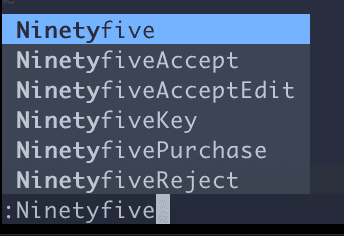
To purchase and set your API key, open neovim and use the :Ninetyfive[Purchase|Key] commands.

vscode window

1. Copy ninetyfive.el to ~/.emacs.d/

2. Configure the below settings in your ~/.emacs file:

(use-package ninetyfive
  :load-path "~/.emacs.d/lisp/"
  :init
  (setq ninetyfive-indexing-mode "yes")
  (setq ninetyfive-cache-consent t)
  :config
  (add-hook 'emacs-startup-hook #'ninetyfive-start))

Billing

Overview

NinetyFive offers flexible billing options for individuals and teams. You can subscribe as an individual user or set up organization billing to cover your entire team under a single account.

Individual Plans

Individual subscriptions are perfect for solo developers. After subscribing, you'll receive an API key that you can use across all supported editor extensions. Manage your subscription, update payment methods, and view invoices from the Billing page in your dashboard.

Team Plans

For teams, we offer per-seat pricing through organization billing. The first user from a domain becomes the admin and can set up billing. Each team member is billed at the same per-seat rate, and new members are automatically prorated when they join. See the Organizations section for more details.

Managing Your Subscription

You can upgrade, downgrade, or cancel your subscription at any time from the dashboard. Cancellations take effect at the end of your current billing period, so you'll retain access until then. If you have an existing API key from another provider, you can sync it to your NinetyFive account during signup.

Organizations

Overview

Organizations allow teams to share a single billing account while giving each member their own unique API key. This is ideal for companies and teams who want centralized billing with individual usage tracking.

Automatic Enrollment

When users sign in with Google using a custom domain (e.g., @yourcompany.com), they are automatically enrolled into an organization based on their email domain. Consumer email domains like Gmail, Outlook, and Yahoo are excluded from automatic organization creation.

Roles

  • Admin - The first user from a domain becomes the admin. Admins can set up billing, manage members, and remove users from the organization.
  • Member - Subsequent users from the same domain join as members. Members have access to the organization's subscription but cannot manage billing.

Billing

Once an admin sets up billing for the organization, all current members are included in the subscription. When new members join (by signing in with a matching domain), they are automatically added to the billing and prorated for the remainder of the billing period. This allows new team members to be productive immediately without manual intervention.

Managing Members

Admins can remove members from the organization at any time. When a member is removed, they lose access to the organization's subscription and are removed from billing. The subscription quantity is automatically adjusted.

API Keys

After an organization is set up with billing, each member can generate their own unique API key from the Billing page. These keys uniquely identify each member in the system, allowing for individual usage tracking while billing remains centralized at the organization level.

Storage

Configure data retention and repository indexing rules. Coming soon.

Last updated 2026-01-14